Compose
Sample characters, settings, objects, and moral themes.
Slot-based promptsarXiv:2603.14563 · cs.CL
A synthetic combinatorial corpus of children's stories in 17 Indic languages, built to help small language models learn coherent language from clean, simple narratives.
Statistics reported in the paper release
The premise
Why this corpus exists
The web is noisy, structurally complex, and unevenly distributed across languages. For underrepresented Indic languages, that makes foundational model training especially difficult.
Multilingual TinyStories replaces that noise with concise narratives written for a five-year-old's reading level. The constrained vocabulary helps compact models learn syntax, semantics, and basic narrative reasoning without being overwhelmed by jargon.
From prompt to corpus
Seven languages are generated natively with Sarvam-M. A validated Gujarati split then becomes the pivot for expansion into ten more languages.
Sample characters, settings, objects, and moral themes.
Slot-based promptsBuild a fresh instruction from millions of combinations.
15+ archetypesSarvam-M writes short native-script stories with controlled decoding.
7 native languagesCheck length, deduplicate, and remove Latin-script leakage.
Programmatic QATranslate the clean Gujarati split into ten additional languages.
17 total languagesNative generation · gu, kn, ml, or, pa, ta, te
Cross-lingual expansion · as, doi, gom, mai, mni, ne, sa, sat, sd, ur
Combinatorial prompt engineering
= 3,000,000 base combinations
Adapted from the problem-solving template in Appendix B.
Paper release by language
Native Sarvam-M generation
Gujarati-pivot translation
Bar length represents token count
Diversity analysis
Distinct-2 measures the share of unique two-word sequences. Native-generation splits generally show the strongest lexical variety, while translated splits remain meaningfully diverse.
Source: Table 1 in the paper.
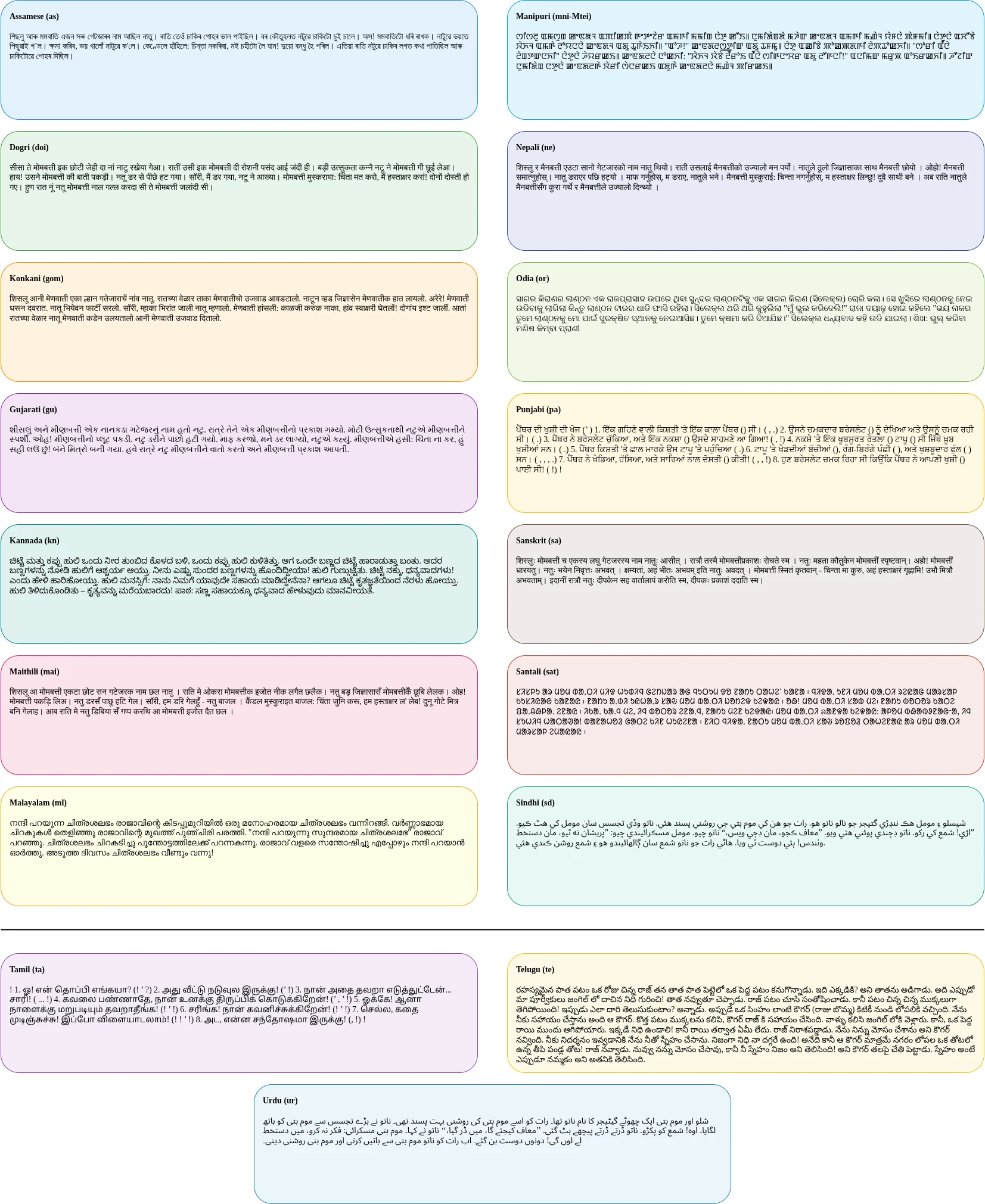
Figure 2 · Samples from the dataset
Native-script corpus
Every split is localized to its native writing system. Language-specific Unicode filters remove Latin characters while preserving punctuation and narrative flow.
script-aware filters tailored to every language split
Built to be used
Use short, constrained narratives to teach grammatical structure and basic coherence.
Compare a shared narrative distribution across 17 low-resource language settings.
Prototype story completion, continuation, and child-oriented language experiences.
Open research
The dataset is published on Hugging Face under CC BY 4.0. Generation and filtering scripts are available in the companion repository.
from datasets import load_dataset

# Load the Gujarati split
stories = load_dataset(
    "deeponh/multilingual-tinystories",
    split="gu"
)@article{halder2026multilingual,
title={Multilingual TinyStories: A Synthetic
Combinatorial Corpus of Indic Children's Stories
for Training Small Language Models},
author={Halder, Deepon and Mukherjee, Angira},
journal={arXiv preprint arXiv:2603.14563},
year={2026}
}